Czech Republic Language: What Do Czechs Speak? (2026 Guide)
 Moderated by Tomas Kauer

The official language of the Czech Republic is Czech (čeština) — a West Slavic language spoken by about 10.7 million people, closely related to Slovak and Polish. It uses the Latin alphabet with 42 letters including diacritical marks (háčky and čárky). English is widely understood in Prague and tourist areas but much less so in smaller towns.
Czech language: at a glance
| Attribute | Detail |
|---|---|
| Native name | Čeština / Český jazyk |
| Language family | Indo-European → Balto-Slavic → Slavic → West Slavic |
| Closest relatives | Slovak (mutually intelligible), Polish, Sorbian |
| Native speakers | ~10.7 million (Czechia) + ~2 million diaspora |
| Writing system | Latin alphabet, 42 letters |
| Diacritics | á é í ó ú ů ý (long vowels); č ď ě ň ř š ť ž (háček) |
| Grammatical cases | 7 (nominative, genitive, dative, accusative, vocative, locative, instrumental) |
| Grammatical gender | 3 (masculine animate, masculine inanimate, feminine, neuter) |
| Official status | Czech Republic, EU |
| Dialect regions | Common Czech (central), Moravian, Silesian |
Is Czech related to Russian?
Both are Slavic languages but Czech is West Slavic (with Slovak and Polish), while Russian is East Slavic. Czechs and Slovaks understand each other with little effort; Czech and Polish share 60–70% of vocabulary but are harder to follow in speech. Czech and Russian share roots but are not mutually intelligible without study.
What makes Czech famously hard?
- Seven grammatical cases — every noun, pronoun, adjective, and numeral declines seven ways.
- The letter “ř” — a raised alveolar trill, unique to Czech. Native speakers often say it’s the hardest sound in any language.
- Consonant clusters — words like čtvrtek (Thursday) and zmrzlina (ice cream) have no vowels in parts.
- Grammatical gender affects verbs, pronouns, and even past-tense verb endings — “I was” is byl jsem for a man, byla jsem for a woman.
- Perfective vs. imperfective verb aspect — every action has two verbs for completed vs. ongoing action.
Essential Czech phrases for visitors
| Czech | Pronunciation | English |
|---|---|---|
| Dobrý den | DOH-bree den | Hello (formal, daytime) |
| Ahoj | AH-hoy | Hi / bye (informal) |
| Děkuji | DYEK-oo-yih | Thank you |
| Prosím | PROH-seem | Please / you’re welcome |
| Ano / Ne | AH-noh / neh | Yes / No |
| Promiňte | PROH-min-teh | Excuse me / sorry |
| Jedno pivo, prosím | YED-noh PEE-voh PROH-seem | One beer, please |
| Zaplatíme, prosím | zah-PLAH-tee-meh PROH-seem | The bill, please |
| Na zdraví! | NAH ZDRAH-vee | Cheers! |
| Nemluvím česky | NEH-mloo-veem CHESS-kee | I don’t speak Czech |
| Mluvíte anglicky? | MLOO-vee-teh AN-glits-kee | Do you speak English? |
For a complete phrase guide with pronunciation audio notes, see our Essential Czech Phrases for Travelers.
Do people in Prague speak English?
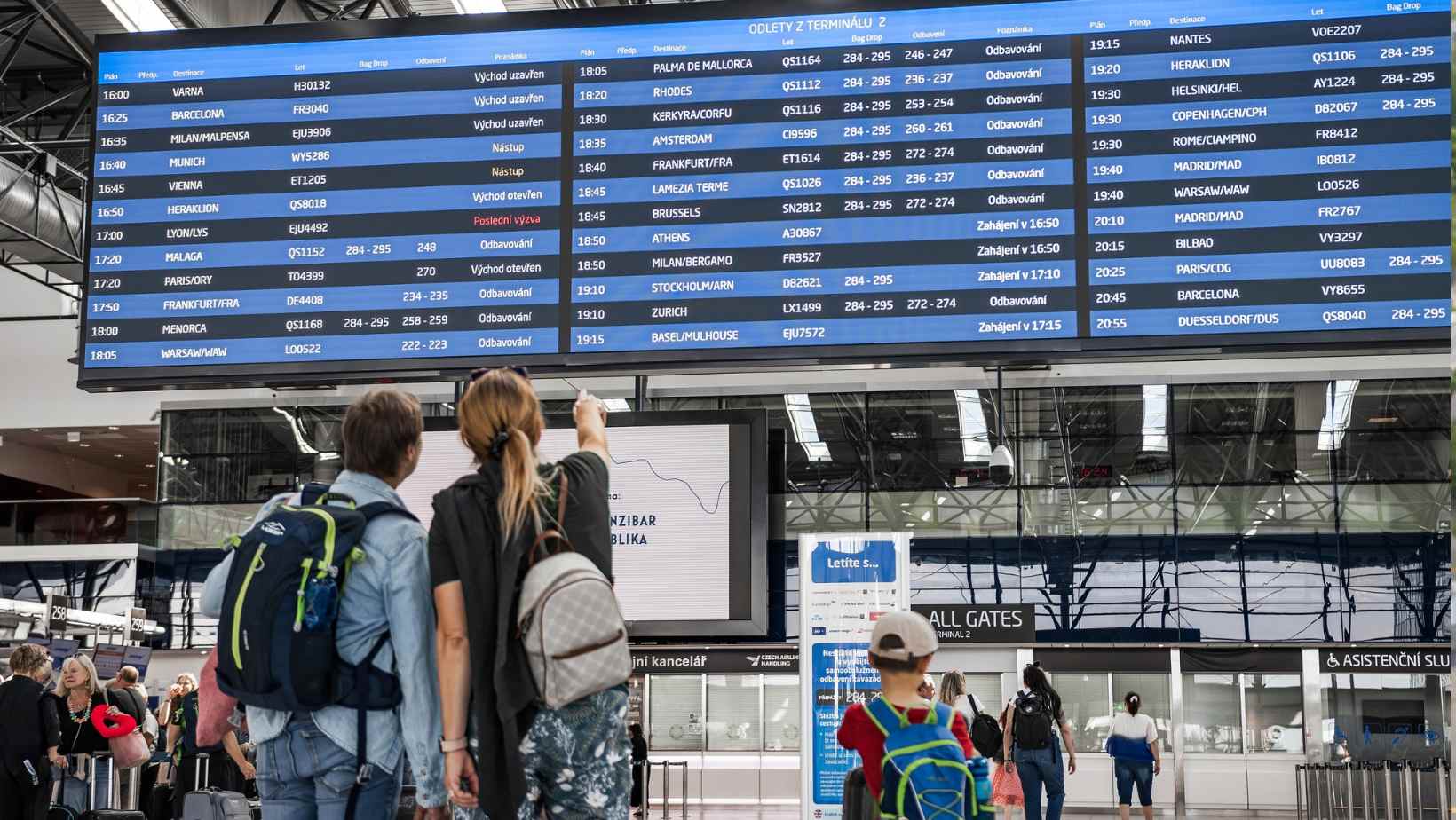
In Prague’s tourist zones — yes, widely. In restaurants, hotels, museums, and transport, you’ll get by in English. Czechs under 40 typically have solid English; many under 30 are fluent. Outside Prague the picture changes: in Brno, Český Krumlov, Karlovy Vary and Kutná Hora you’ll be fine in English; in villages or with older people, learning a few phrases makes a real difference.
German, Russian, Polish — what else is spoken?
- Slovak is near-universally understood as a second language (both languages were official in Czechoslovakia 1918-1993).
- German was once the common second language and remains widely studied, especially in the border regions and Prague business circles.
- Russian was mandatory in schools under communism (pre-1989); most Czechs over 50 studied it but very few speak it willingly.
- English has been the main foreign language in schools since 1990 and is now the default international language for younger Czechs.
Czech alphabet
The Czech alphabet has 42 letters, including the base Latin alphabet plus letters with háček (ˇ) and čárka (ˊ): a á b c č d ď e é ě f g h ch i í j k l m n ň o ó p q r ř s š t ť u ú ů v w x y ý z ž.
“Ch” counts as one letter and is pronounced like the German “ch” in “Bach” or the Scottish “loch”.
Frequently asked questions
What language do Czechs speak?
Czech (čeština). The official language of the Czech Republic.
Is Czech the same as Czechoslovakian?
“Czechoslovakian” is not really a language — Czechoslovakia (1918–1993) had two official languages, Czech and Slovak. When people say “Czechoslovakian,” they usually mean Czech.
How difficult is Czech to learn?
The U.S. Foreign Service Institute rates it Category III (hard) — around 1,100 class hours to reach professional proficiency for an English speaker. Mandarin is Category IV; French is Category I.
Do I need to learn Czech to visit Prague?
No. Learning 5–10 phrases is appreciated but not essential. English will get you through nearly every tourist interaction.
How many people speak Czech worldwide?
Approximately 13 million — 10.7 million in Czechia, with sizeable communities in Slovakia, the United States (Texas, Chicago, Nebraska), Canada, and Austria.
Learn Czech + travel gear
- “Czech-English, English-Czech Dictionary & Phrasebook” — Hippocrene traveller’s edition.
- “Colloquial Czech” (Routledge course)
- Rick Steves Prague guidebook — has a Czech phrase primer.
- “Prague Winter” by Madeleine Albright